Anders Sunna Sápmi, Sweden, b. 1985
Wind is the Last Witness, 2025
Oil and mixed media on panel
49 1/4 x 68 7/8 in
125 x 175 cm
This work once again positions the Sámi homeland of Sápmi as a courtroom in which conflicting voices fight to be heard. At the centre is an apparently tranquil landscape that...
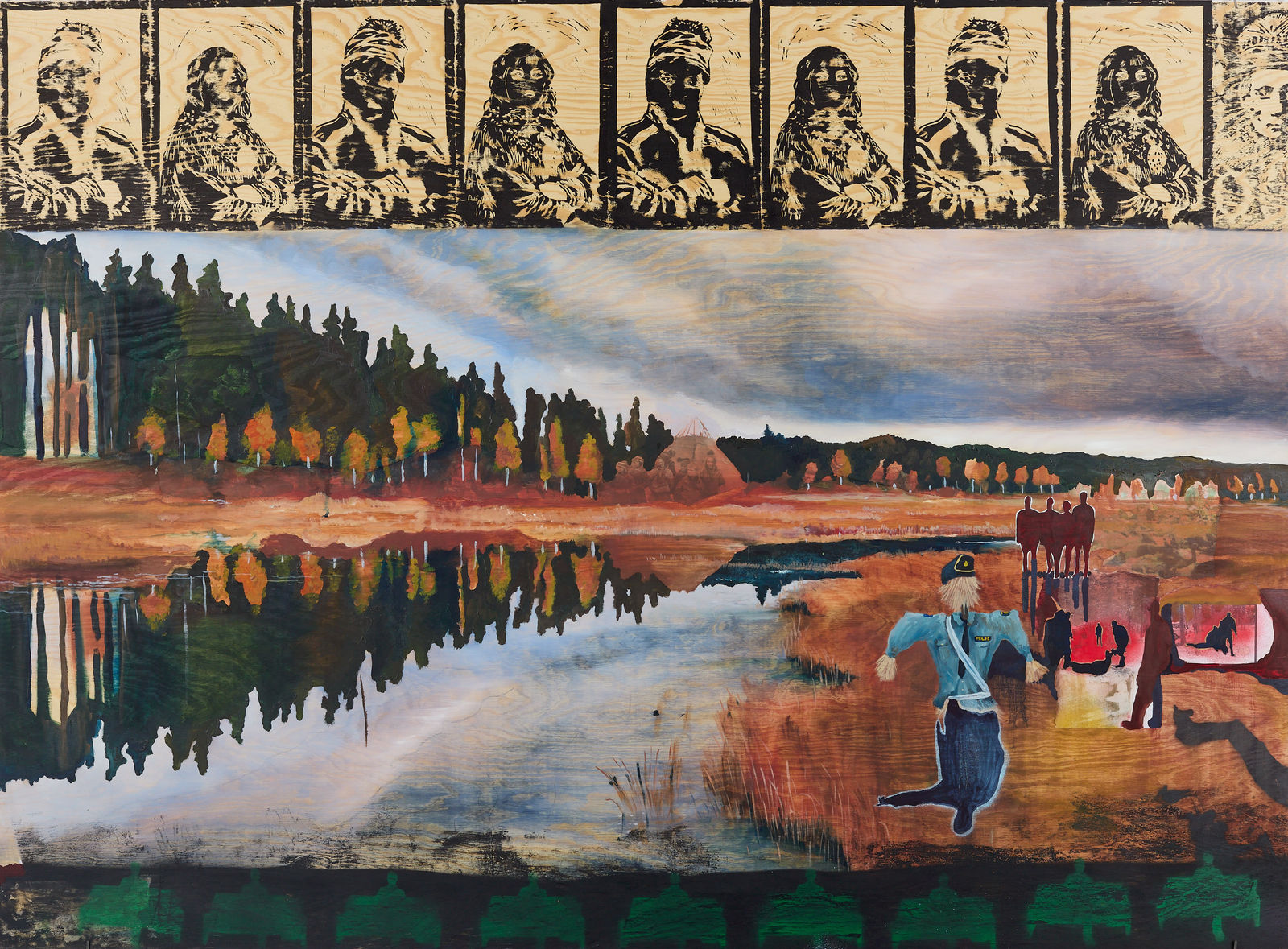
This work once again positions the Sámi homeland of Sápmi as a courtroom in which conflicting voices fight to be heard. At the centre is an apparently tranquil landscape that stretches to a point we cannot see. The water bisects the central plane of the painting so that the sky, rendered in washes of oil paint, is mirrored below, the grain of the wood flowing through both the corporeal and spiritual worlds. Photographs of Sámi ancestors are collaged into the forest, the bodies of trees and people merging. A traditional lavvu, a tent used by the nomadic Sámi, reaches towards the sky and water, symbolic of a fragile past and future.
As our eye follows the river, the landscape is obstructed by four blood red figures. Scores of dead reindeer lie in a collaged heap to their right. Their presence introduces an entirely different visual language; stencils and spray paint that cut crudely into the landscape. These figures represent a catalogue of violence against the Sámi, originating with the colonising Gustav Vasa of Sweden and splintering out to include minority groups who consider themselves Sámi but whom many, including Sunna, see as settlers continuing that ideology. These battle lines are drawn across the face of the work, with Sunna and his wife in balaclavas printed in a frieze across the top of the painting and an opposing line of courtroom furniture tracking a dirty line across the bottom. The land watches and waits.